Khi ăn uống nên xem như dùng thuốc để trị bệnh, dù ngon dù dở cũng chỉ dùng đúng mức, đưa vào thân thể chỉ để khỏi đói khát mà thôi.Kinh Lời dạy cuối cùng
Trực giác của tâm thức là món quà tặng thiêng liêng và bộ óc duy lý là tên đầy tớ trung thành. Chúng ta đã tạo ra một xã hội tôn vinh tên đầy tớ và quên đi món quà tặng. (The intuitive mind is a sacred gift and the rational mind is a faithful servant. We have created a society that honor the servant and has forgotten the gift.)Albert Einstein
Mỗi ngày, hãy mang đến niềm vui cho ít nhất một người. Nếu không thể làm một điều tốt đẹp, hãy nói một lời tử tế. Nếu không nói được một lời tử tế, hãy nghĩ đến một việc tốt lành. (Try to make at least one person happy every day. If you cannot do a kind deed, speak a kind word. If you cannot speak a kind word, think a kind thought.)Lawrence G. Lovasik
Giặc phiền não thường luôn rình rập giết hại người, độc hại hơn kẻ oán thù. Sao còn ham ngủ mà chẳng chịu tỉnh thức?Kinh Lời dạy cuối cùng
Trời sinh voi sinh cỏ, nhưng cỏ không mọc trước miệng voi. (God gives every bird a worm, but he does not throw it into the nest. )Ngạn ngữ Thụy Điển
Cuộc sống là một sự liên kết nhiệm mầu mà chúng ta không bao giờ có thể tìm được hạnh phúc thật sự khi chưa nhận ra mối liên kết ấy.Tủ sách Rộng Mở Tâm Hồn
Cách tốt nhất để tiêu diệt một kẻ thù là làm cho kẻ ấy trở thành một người bạn. (The best way to destroy an enemy is to make him a friend.)Abraham Lincoln
Chúng ta nên hối tiếc về những sai lầm và học hỏi từ đó, nhưng đừng bao giờ mang theo chúng vào tương lai. (We should regret our mistakes and learn from them, but never carry them forward into the future with us. )Lucy Maud Montgomery
Ai sống quán bất tịnh, khéo hộ trì các căn, ăn uống có tiết độ, có lòng tin, tinh cần, ma không uy hiếp được, như núi đá, trước gió.Kinh Pháp Cú (Kệ số 8)
Việc đánh giá một con người qua những câu hỏi của người ấy dễ dàng hơn là qua những câu trả lời người ấy đưa ra. (It is easier to judge the mind of a man by his questions rather than his answers.)Pierre-Marc-Gaston de Lévis
Cơ hội thành công thực sự nằm ở con người chứ không ở công việc. (The real opportunity for success lies within the person and not in the job. )Zig Ziglar
 Trang chủ
Trang chủ »» Danh mục »» »» Buddhism Around The World »» He Walks Like Christ, He Walks with the Buddha »»
 Xem Mục lục
Vietnamese || Đối chiếu song ngữ
Xem Mục lục
Vietnamese || Đối chiếu song ngữ

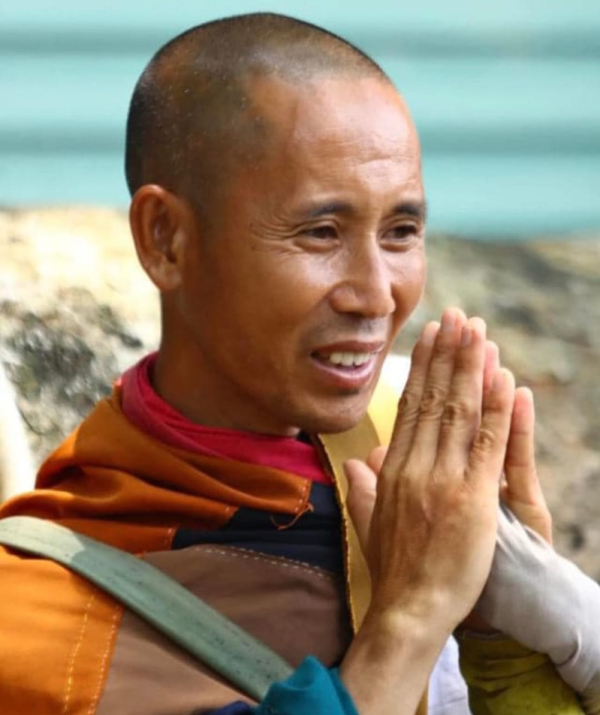
A Tribute to Thích Minh Tuệ
December 12, 2025
A wordless teacher: when presence becomes teaching
Along dusty Vietnamese roads, a barefoot monk walks in silence. His robe is patched from discarded cloth; he carries no sandals, no bag, only an alms bowl. This is Thích Minh Tuệ (Lê Anh Tú), a contemporary ascetic whose radical simplicity has drawn extraordinary attention across spiritual traditions. He offers no sermons, claims no title, and carries no scriptures, yet his silence teaches.
Vietnam is home to 24 centuries of Buddhism and five centuries of Christianity—traditions that have long shared a landscape of quiet coexistence. Against this backdrop, the widespread reverence for a silent monk is striking. Buddhists see in him the austerity of the early forest arahants, while Catholics—remarkably numerous among his admirers—see in his poverty and humility something of their own contemplative tradition. His silence speaks across boundaries.
A meteoric rise: a silent pilgrimage that captivated a nation
Few figures in Vietnam’s long Buddhist history have risen as swiftly, or as quietly, to prominence as Thích Minh Tuệ. His visibility began in early 2024, when brief, un-captioned clips of a lone ascetic walking rural roads quietly went viral. A barefoot monk bowing to strangers proved unexpectedly catalytic.
By April–May 2024, this understated figure had become a national and international phenomenon. Global web-search interest reached hundreds of millions of monthly queries. Millions followed volunteer livestreams. Devotees crossed borders to offer a single grain of rice. Buddhists, Catholics, Hindus, Muslims, and secular observers offered reverence. Vietnamese called him “a mirror of conscience.”
What emerged was a global sangha without walls—drawn not by doctrine or institution, but by embodied renunciation. One man walking became a mirror. And as the world watched, deeper resonances appeared: the austerity of the early arahants and the poverty of the Gospel recognizing the same moral clarity in one silent pilgrim.
The dhutaṅga ideal: preserving the heartwood of practice
The devotion surrounding Thích Minh Tuệ arises from something profound: he embodies the dhutaṅga austerities of the earliest forest monastics with remarkable fidelity. His rag robe, alms-round subsistence, outdoor sleeping, noble silence, and ceaseless pilgrimage evoke Mahākassapa, the Buddha’s foremost ascetic disciple. Vietnamese monastics say he preserves “the heartwood of practice.”
The dhutaṅga practices—13 optional austerities praised by the Buddha—have always represented Buddhism’s most rigorous path. Thích Minh Tuệ lives most of them continuously: he wears robes stitched from discarded cloth, eats only unsolicited alms food before noon, sleeps outdoors (sometimes standing), refuses money and modern conveniences, and maintains near-total silence. His practice mirrors the contentment described in the Theragāthā: “Content with any robe, any alms food, any lodging.”
Most Venerable Thích Thông Lai observed that “he embodies the Vinaya more faithfully than many in robes.” Ven. Thích Minh Đạo compared him directly to Mahākassapa. Most Ven. Thích Giới Đức called him “a living image of a true renunciant,” while Ven. Thích Bửu Khánh noted that “he carries the fragrance of the forest monks.” A Vietnamese Buddhist nun remarked simply: “He keeps alive the austerities the Buddha praised.”
These recognitions matter because they come from within the tradition itself—senior monastics acknowledging that this quiet figure walks a path to which many aspire but few attain.
An unexpected interfaith response
While Buddhist recognition provides the foundation for understanding Thích Minh Tuệ’s significance, an unexpected phenomenon has emerged: his life has stirred a deep resonance among Christians, particularly Vietnamese Catholics. Priests have mentioned him in homilies, calling him “a Gospel without words” and noting that “his silence is more powerful than thousands of sermons.” Fr. Joseph Trương Hoàng Vũ, SJ, observed: “There is no conversion—only communion.”
This cross-traditional recognition reflects something important: when ascetic discipline is lived with complete sincerity, it becomes universally legible. The radical poverty and humility that Buddhists recognize as dhutaṅga, Christians recognize through their own contemplative tradition. Both see the same qualities: simplicity without pretense, compassion without claim, and a presence that calms rather than commands.
The parallels run deeper than surface similarities. What Buddhists understand as suññatā—the emptying of self, the release from grasping and ego-clinging—finds an echo in the Christian concept of kenosis, the self-emptying that makes room for the sacred. The Buddhist path teaches non-attachment as liberation; the Christian mystics speak of emptying oneself to be filled with divine presence. Both recognize that clinging to possessions, status, and self-identity creates suffering, and both see freedom in the radical letting-go that Thích Minh Tuệ embodies.
The Buddha instructed his disciples: “A bhikkhu is content with any kind of robe, with any kind of alms food, with any kind of lodging. . . . Just as a bird, wherever it goes, flies with its wings as its only burden, so too the bhikkhu is content everywhere.” Christ sent out his disciples with similar instructions: “Take nothing for your journey: no staff, nor bag, nor bread, nor money—not even an extra tunic.” Both traditions recognize that true freedom comes through radical simplicity, that holiness is carried in empty hands.
Voices from Hindu, Muslim, and secular communities have added to this chorus. A swami in Bodh Gaya remarked: “This man walks as the ancients did: no desire, no anger, only surrender.” A Muslim cleric in Malaysia noted: “His silence speaks truth. He asks for nothing, yet gives peace to all who see him.” Even secular observers have reported feeling moved by an authenticity they rarely encounter.
The convergence reveals a simple truth: embodied asceticism transcends doctrinal boundaries while remaining rooted in tradition.
Devotion without borders: reverence along the silent path
As Thích Minh Tuệ’s pilgrimage extended beyond Vietnam, reverence shifted from online fascination to lived encounter. Wherever he walked, devotion appeared spontaneously, as if an ancient memory of the wandering mendicant awoke.
Across Thailand, Laos, Malaysia, Indonesia, Singapore, Sri Lanka, and India, people responded with remarkable consistency: bowing in silence, offering fruit or water, pausing mid-task, gathering without summons. The sight of a barefoot ascetic carrying only an alms bowl stirred recognition older than any one tradition.
Within Vietnam, gestures deepened. Streets were swept before his arrival. Flower petals were laid along paths. Families waited quietly on bridges and roadsides. These acts revealed how deeply the mendicant ideal endures in Vietnamese spiritual consciousness.
Among overseas Vietnamese in Australia, Europe, Japan, Korea, and the United States, many traveled hours simply to offer a grain of rice, walk behind him briefly, or see him once in their lifetime. One monk walked, and people remembered something essential about spiritual practice: that it can be lived, not merely discussed.
A cultural flowering: creativity born of silence
Although he teaches nothing verbally, Thích Minh Tuệ’s pilgrimage has sparked remarkable creative expression. His journey has inspired songs, poems, chants, sculptures, calligraphy, photography series, documentaries, and independent books. These works arose organically, drawn into being by the magnetism of embodied renunciation.
His patchwork robe, stitched from roadside cloth, has become a symbol appearing in drawings, textiles, pottery, and knitted figures. Its plainness became shorthand for the sincerity people sensed in him. Volunteer livestreams and translations have carried his journey worldwide, transforming an ascetic’s walk into a shared cultural event driven entirely by lay devotion.
Echoes of Mahākassapa: the path of radical simplicity
Since June 2025, Thích Minh Tuệ has observed rare dhutaṅga austerities with extraordinary consistency: sleeping standing up, living solely on unsolicited alms, eating one vegan meal before noon, and walking nearly 20 kilometers a day across more than 6,000 kilometers.
His life echoes the great forest ascetics. Like Mahākassapa, who wore rag robes from scraps, slept in forests and charnel grounds, and walked endless alms-rounds, Thích Minh Tuệ embodies what the Aṅguttara Nikāya describes: “Just as a bird, wherever it goes, flies with its wings as its only burden, so too the bhikkhu is content everywhere.”
The comparison to Mahākassapa is not rhetorical. Both refused comfort, rejected wealth and status, and demonstrated that equanimity is not passive acceptance but active freedom. Both became custodians of authentic ascetic practice—Mahākassapa preserving the Dharma’s heartwood in the Buddha’s time, and Thích Minh Tuệ doing so in ours.
In his barefoot path, some observers see a bridge between traditions: the forest sage Mahākassapa and St. Francis of Assisi. The one who slept in charnel grounds and the one who called himself “married to Lady Poverty” meeting in the unadorned integrity of a patchwork robe. Both lived in radical simplicity; both renounced wealth to walk among the poor; both demonstrated that holiness requires no possession. Whether understood through the lens of dhutaṅga or Gospel poverty, the pattern remains consistent: freedom through renunciation, compassion through emptying oneself of claim.
The fragrance of holiness: sugandha in motion
Across Buddhist history, purity of life is often described as a fragrance: sugandha. The Dhammapada teaches: “The fragrance of the virtuous pervades every direction.” Companions describe something similar about Thích Minh Tuệ: a calm, unburdened presence that reads as purification.
This “fragrance” is not a literal aroma but a moral clarity; the quiet radiance of a life emptied of grasping. It is what the forest arahants embodied and what contemporary practitioners recognize in one who walks the ancient path with modern feet.
Boundless compassion: mettā in motion
Discipline frames Thích Minh Tuệ’s life, but compassion—precise, unwavering, and wordless—defines it. Across Vietnam and South Asia, witnesses describe the same pattern: when mocked, he smiles; when shoved, he remains still; when accused, he offers no defense; when offered food, he bows.
In Bodh Gaya, when stones were thrown, he neither flinched nor retaliated; he bowed in prayer for the attackers. The Dhammapada’s teaching becomes visible: “Hatred is never appeased by hatred . . . only by love.”
His compassion is not sentimental; it is moral clarity lived with exactness. Asked about organ donation, he replied that he would give only if it caused no harm, was lawful, and followed 10 days of purification—charity guided by ethics, not emotion. The Metta Sutta instructs: “Just as a mother would protect her only child with her life . . . cultivate a boundless heart.” Thích Minh Tuệ’s actions demonstrate this cultivation in real time.
Witnesses describe a presence that quiets without commanding, blesses without performing, and consoles without claiming to heal. This is not charisma but the natural radiance of a mind shaped by fearlessness and goodwill. For those practicing the Buddhadhamma, this is nibbāna in motion—a glimpse of what the path produces when walked with complete sincerity.
A child of all beings: filial reverence as universal kinship
One of Thích Minh Tuệ’s most striking habits is how he addresses others. To monks, villagers, police, children—even critics—he says “Cha, Mẹ” (Father, Mother) and calls himself “Con” (Child). This is not courtesy; it is cosmology.
The Avataṃsaka Sūtra teaches: “All sentient beings have been our mothers.” By standing as “Child” before each being, he dissolves boundaries of caste, class, nation, and creed. A gift becomes care; a bow becomes gratitude; silence becomes belonging.
Companions say his filial language often disarms conflict. A police officer becomes “Father,” not adversary. A critic becomes “Mother,” not enemy. A stranger becomes family, not threat. To call all beings “Father” and “Mother” is to move through the world not as a monk seeking status, but as a child of all beings—innocent, vulnerable, and profoundly free.
Asceticism as a living transmission: a call for protection
Thích Minh Tuệ shows that true asceticism needs no sermon. His silence, poverty, and compassion are instantly legible across traditions: Buddhists see dhutaṅga; Catholics see Gospel poverty; Hindus see tapas; Muslims see taslim.
When virtue is lived without claim, it becomes a universal language—a living transmission of the dhutaṅga path that many study but few embody. When the Buddha praised Mahākassapa’s austerities, he was not endorsing suffering but recognizing freedom: the capacity to be content with little, to meet hostility with equanimity, to walk through the world unburdened.
Such clarity draws devotion—and sometimes provokes resistance. When millions turn toward one unattached walker, institutions may feel bypassed. Attempts to restrain genuine practice reveal not its danger, but fear of what cannot be controlled. Holiness that arises outside formal authority is often treated as disruption.
To protect authentic practitioners is to protect what the Buddha himself praised: the forest path, the ascetic ideal, the living example that reminds us what liberation looks like in human form. This is responsibility, not mere reverence. It means preventing the suppression of genuine holiness, recognizing institutional fear when it masquerades as order, and preserving space for authentic spiritual life.
Conclusion: the mirror we need
Thích Minh Tuệ walks as the early arahants walked—not to gather followers, but to walk free. That millions have been moved by this simple fact speaks to a fundamental and universal truth: we recognize authenticity across all distances, even through screens, even in silence.
In an age of noise, a man who owns nothing, needs little, and harms none offers rare moral clarity. His body becomes text. His steps become teaching. His silence becomes revelation.
Let the world not turn away. Let the world not fall silent when silence walks among us. In his footsteps, we see not a saint to worship but a mirror reflecting our own highest capacities: humility, compassion, trust, and the radical freedom of needing almost nothing. Thích Minh Tuệ’s pilgrimage does not ask us to change our doctrine, but to safeguard what is most human in ourselves.
The path is old. The walker is contemporary. The teaching, timeless, continues.
(Source: Buddhist Door)
DO NXB LIÊN PHẬT HỘI PHÁT HÀNH




Mua sách qua Amazon sẽ được gửi đến tận nhà - trên toàn nước Mỹ, Canada, Âu châu và Úc châu.
Quý vị đang truy cập từ IP 216.73.216.119 và chưa ghi danh hoặc đăng nhập trên máy tính này. Nếu là thành viên, quý vị chỉ cần đăng nhập một lần duy nhất trên thiết bị truy cập, bằng email và mật khẩu đã chọn.
Chúng tôi khuyến khích việc ghi danh thành viên ,để thuận tiện trong việc chia sẻ thông tin, chia sẻ kinh nghiệm sống giữa các thành viên, đồng thời quý vị cũng sẽ nhận được sự hỗ trợ kỹ thuật từ Ban Quản Trị trong quá trình sử dụng website này.
Việc ghi danh là hoàn toàn miễn phí và tự nguyện.
Ghi danh hoặc đăng nhập
 Viên Hiếu Thành Huệ Lộc 1959 Bữu Phước Chúc Huy Minh Pháp Tự minh hung thich Diệu Âm Phúc Thành Phan Huy Triều Phạm Thiên Trương Quang Quý Johny Dinhvinh1964 Pascal Bui Vạn Phúc Giác Quý Trần Thị Huyền Chanhniem Forever NGUYỄN TRỌNG TÀI KỲ Dương Ngọc Cường Mr. Device Tri Huynh Thích Nguyên Mạnh Thích Quảng Ba T TH Tam Thien Tam Nguyễn Sĩ Long caokiem hoangquycong Lãn Tử Ton That Nguyen ngtieudao Lê Quốc Việt Du Miên Quang-Tu Vu phamthanh210 An Khang 63 zeus7777 Trương Ngọc Trân Diệu Tiến ... ...
  Sám hối
 Tôn Sư Trọng Đạo
 Những bát cơm phiếu mẫu - Phần 2
 Vấn đề tri kiến trong các trường phái Phật giáo Tây Tạng